

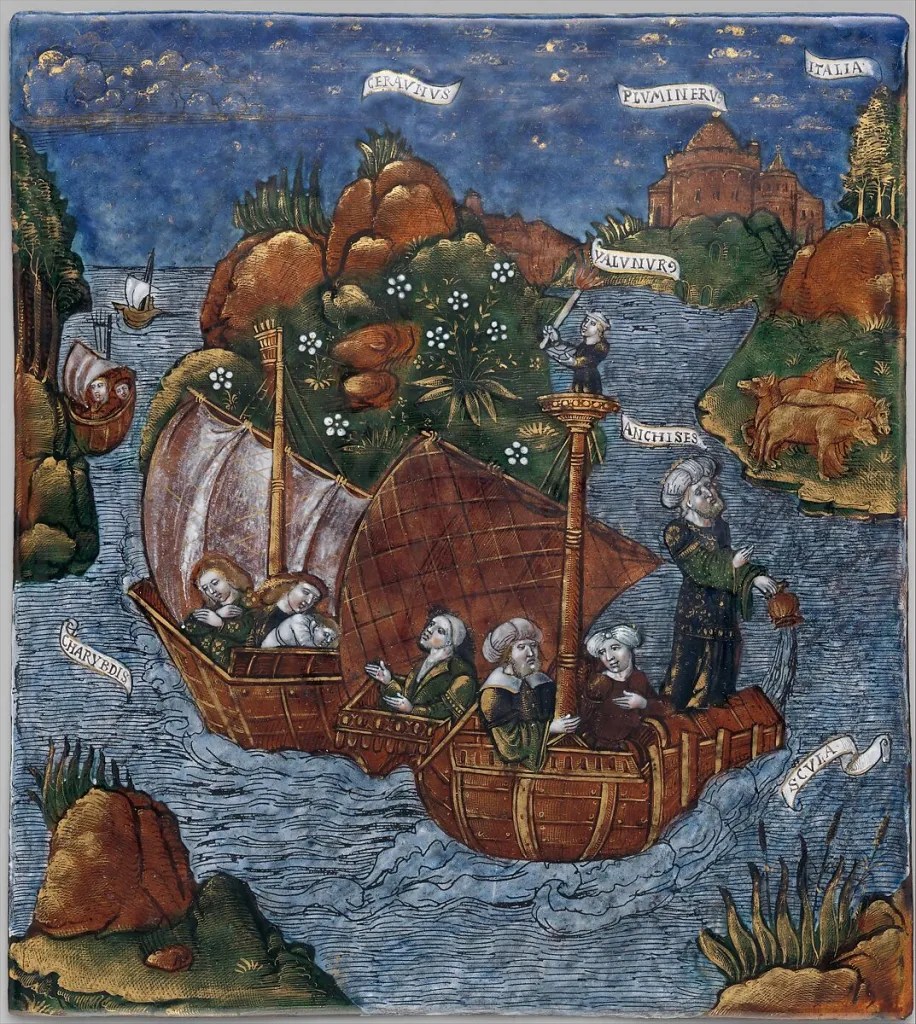


Over the course of these nine months, our reading circle will set out on a long literary journey, with the Odyssey as our guide. It is a story of wandering and homecoming, disguise and recognition, temptation and survival—and, of course, of the desire to find one’s way home. We will read it slowly, from October to June, so that it stays with us throughout the whole journey.
Along the way, we will read other great stories of travel, adventure, exile, heroism, loss, and return. Some are closely connected to Homer; others come from very different cultures and tell very different kinds of stories. Gilgamesh, the Shahnameh, Hayy ibn Yaqzan, the Ramcharitmanas, and Journey to the West will take us into other worlds and introduce us to other kinds of heroes and journeys. Greek tragedy, Plato, and Aristotle will give us different ways of looking at the world around Homer, while Virgil’s Aeneid takes the Homeric story in a new direction.
As we move closer to our own time, the old stories begin to appear in surprising new forms. Milton turns epic into a story of heaven, rebellion, and the fall of humankind. Joyce brings Odysseus to the streets of Dublin. Césaire and Walcott use journeys and homecomings to explore colonialism, exile, memory, and belonging. And Atwood returns to Ithaca to tell the story from Penelope’s point of view—and from the point of view of women who hardly get to speak in Homer at all.
The nine months are divided into three capsules, each lasting roughly three months. The Odyssey will continue throughout, while the other readings will change from one capsule to the next. The idea is not that all these books come from Homer. Rather, the Odyssey gives us a thread to follow as we move between very different times, places, and traditions—and discover how many different ways there are to tell a story about a journey, a hero, and the search for home.

© 2025 Kiklos Learning. All Rights Reserved.